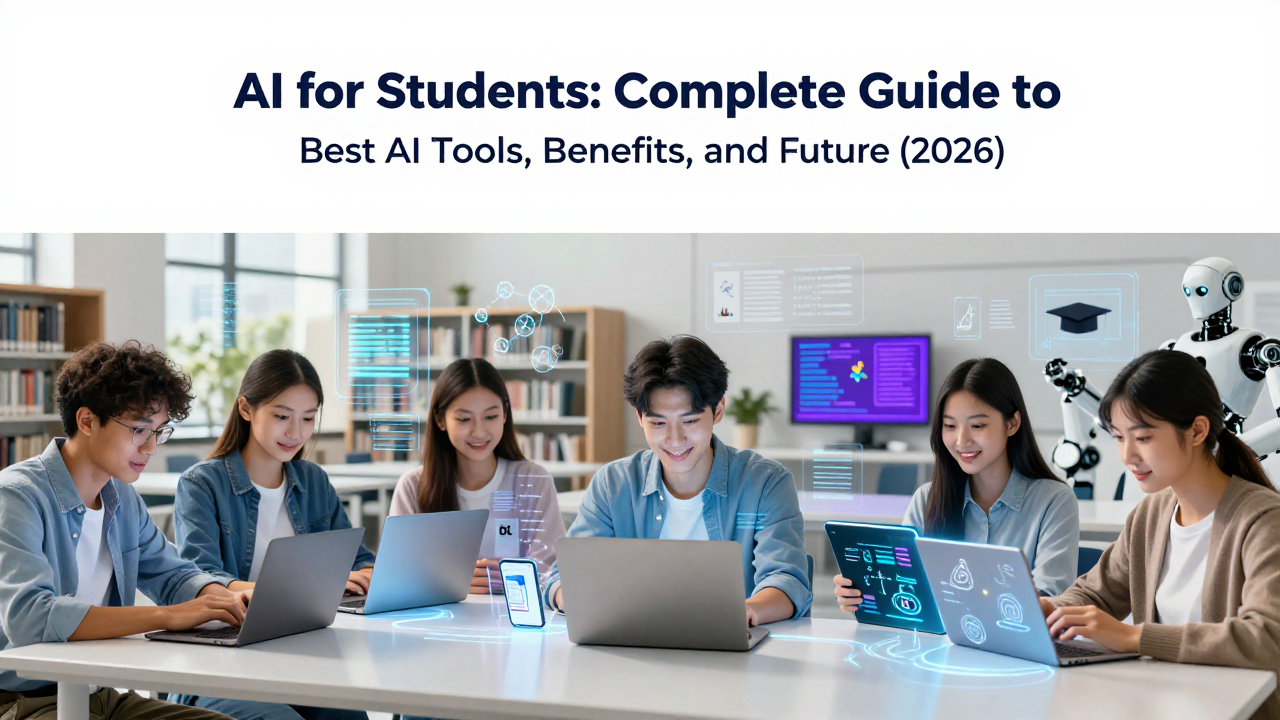
Artificial Intelligence (AI) for students refers to AI-powered tools and technologies that help learners study more effectively, complete assignments, improve writing, solve problems, conduct research, and develop new skills. In 2026, AI has become an essential learning companion for students from elementary school to college and university.
Education has changed dramatically over the past few years. Students are no longer limited to textbooks, classrooms, and traditional study methods. Instead, they have access to intelligent AI assistants that can explain complex topics, generate practice questions, summarize lengthy chapters, improve essays, translate languages, create study plans, and even help prepare for exams.
In the United States, millions of students now use AI every day to save time and learn more efficiently. Whether someone is studying mathematics, science, programming, history, business, or English, AI-powered learning tools can provide instant explanations and personalized support. When used responsibly, these technologies encourage deeper understanding instead of simply providing quick answers.
As AI continues to evolve in 2026, students who learn how to use these tools wisely gain a significant advantage. They become more productive, better organized, and more confident in their learning journey.
What Does AI for Students Mean?
Artificial Intelligence (AI) for students refers to using computer systems that simulate human intelligence to assist with learning and education.
Instead of replacing teachers, AI acts as a personal learning assistant. It analyzes questions, understands natural language, generates responses, recommends learning resources, and adapts to each student’s learning style.
AI can help students:
- Understand difficult concepts
- Improve academic writing
- Solve mathematical problems
- Learn programming
- Practice foreign languages
- Prepare for exams
- Organize study schedules
- Conduct research
- Generate creative ideas
- Improve productivity
Unlike traditional educational software, modern AI can interact naturally through conversation, making learning more engaging and personalized.
Why AI Is Important for Students
Artificial intelligence has become one of the most valuable educational technologies because it makes learning more personalized and accessible.
Every student learns differently. Some understand through visual explanations, while others prefer examples or step-by-step guidance. AI adapts to these preferences by providing customized explanations that match individual learning styles.
AI also reduces the time spent searching for information. Instead of reading dozens of websites, students can receive organized explanations within seconds.
For busy college students balancing classes, jobs, and extracurricular activities, AI improves productivity by helping organize notes, summarize lectures, and create study plans.
Another important benefit is accessibility. Students with learning disabilities, language barriers, or different educational backgrounds can receive additional support whenever they need it.
How AI Works for Students
Artificial intelligence combines several advanced technologies to understand questions and generate useful responses.
Machine Learning
Machine learning enables AI systems to recognize patterns from enormous datasets. This allows AI to improve its responses over time.
For example, when students ask similar questions, AI learns to explain concepts more clearly.
Natural Language Processing (NLP)
Natural Language Processing allows AI to understand human language.
Students can ask questions naturally, just as they would ask a teacher.
Example:
“Explain photosynthesis like I’m in 8th grade.”
The AI understands both the topic and the requested difficulty level.
Large Language Models
Modern AI assistants are powered by large language models trained on billions of words.
These models can:
- Explain concepts
- Generate essays
- Write code
- Translate languages
- Create quizzes
- Answer questions
- Summarize information
Personalized Learning
Some AI platforms analyze student performance and recommend lessons based on strengths and weaknesses.
Instead of giving every student identical content, AI creates customized learning experiences.
Types of AI for Students
AI technology comes in many forms, each serving different educational needs.
AI Writing Assistants
These tools help students improve grammar, sentence structure, clarity, vocabulary, and overall writing quality.
Common tasks include:
- Essay editing
- Grammar correction
- Email writing
- Research summaries
- Citation assistance
AI Research Assistants
Research AI helps students gather reliable information, summarize articles, compare sources, and understand academic topics more efficiently.
These tools reduce research time while improving information organization.
AI Study Assistants
Study assistants create:
- Flashcards
- Practice quizzes
- Revision notes
- Study schedules
- Chapter summaries
This makes exam preparation faster and more effective.
AI Math Tutors
Math-focused AI explains equations step by step rather than only showing answers.
Students can learn:
- Algebra
- Geometry
- Statistics
- Calculus
- Trigonometry
Understanding the solution process helps improve long-term learning.
AI Coding Assistants
Programming students use AI to:
- Write code
- Debug errors
- Explain programming concepts
- Learn new languages
- Build projects
These assistants are especially useful for beginners learning Python, Java, JavaScript, C++, and SQL.
AI Language Learning Tools
Language AI supports:
- Translation
- Pronunciation practice
- Vocabulary building
- Grammar exercises
- Conversation practice
Students studying Spanish, French, German, Chinese, Japanese, or English benefit from personalized language learning.
AI Note-Taking Tools
Modern AI converts lectures into organized notes automatically.
Students can:
- Record lectures
- Generate summaries
- Highlight important points
- Search notes instantly
This reduces manual note-taking and improves revision.
AI Presentation Tools
Presentation AI helps students create professional slides quickly.
Features often include:
- Automatic slide design
- Content suggestions
- Image recommendations
- Speaker notes
- Visual enhancements
Students save hours while producing polished presentations.
AI Career and Skill Development Tools
Beyond academics, AI helps students prepare for future careers by assisting with:
- Resume writing
- Interview practice
- Portfolio creation
- Career exploration
- Skill recommendations
As employers increasingly value AI literacy, learning these tools has become an important career advantage.
AI for Students in Schools vs. Colleges
Explain how AI is used differently by K–12 students, high school students, college students, and university learners. Discuss classroom learning, online education, homework assistance, and independent study.
Best AI Tools for Homework
Cover how AI helps students complete homework more efficiently while emphasizing responsible use. Include examples for math, science, history, English, and social studies.
AI for Research and Academic Writing
Discuss how AI helps students find information, organize ideas, summarize research papers, create outlines, improve essays, and understand difficult academic concepts.
AI for Exam Preparation
Explain how students can use AI to create study plans, generate quizzes, make flashcards, practice multiple-choice questions, and review important topics before exams.
AI for STEM Students
Focus on how engineering, computer science, mathematics, biology, chemistry, and physics students use AI for calculations, coding, simulations, and data analysis.
AI for Creative Students
Describe how students studying graphic design, music, photography, filmmaking, writing, and digital media use AI to generate ideas, edit projects, and improve creativity.
AI for Online Learning
Explain how AI enhances online courses through personalized learning paths, instant tutoring, adaptive quizzes, progress tracking, and interactive study support.
AI Skills Every Student Should Learn
Introduce essential AI-related skills such as prompt writing, fact-checking, AI ethics, digital literacy, data analysis, automation, and responsible AI usage.
Is AI Safe for Students?
Discuss privacy, data security, plagiarism concerns, misinformation, and ethical use. Explain how students can use AI safely and responsibly.
How Teachers Use AI to Support Students
Explain how educators use AI to create lesson plans, grade assignments, personalize instruction, monitor student progress, and provide faster feedback.
Future of AI in Education (2026–2035)
Explore upcoming trends such as AI tutors, virtual classrooms, adaptive learning systems, augmented reality, personalized education, AI-powered assessments, and lifelong learning.
Common Mistakes Students Make When Using AI
Discuss over-reliance on AI, copying answers without understanding, failing to verify facts, ignoring citations, and violating school academic integrity policies.
Best Practices for Using AI Responsibly
Provide practical guidance on using AI as a learning assistant instead of a shortcut. Encourage students to verify information, cite sources when required, and develop critical thinking skills.
How to Choose the Best AI Tool for Your Needs
Explain what students should consider when selecting an AI tool, including ease of use, accuracy, pricing, privacy, subject support, collaboration features, and device compatibility.
AI Statistics for Students (2026)
Include current educational trends, growing AI adoption in schools and colleges, increasing demand for AI skills in the workforce, and how educational institutions are integrating AI into learning.
AI Career Opportunities for Students
Explain how learning AI today can prepare students for careers in software development, healthcare, finance, education, cybersecurity, marketing, engineering, and data science.
Myths About AI for Students
Address common misconceptions, such as AI replacing teachers, AI always being correct, AI eliminating the need to study, and AI being useful only for computer science students.
The Future Skills Students Need in an AI World
Discuss critical thinking, creativity, emotional intelligence, communication, collaboration, adaptability, digital literacy, and ethical decision-making as essential skills alongside AI proficiency.
FAQs
What is AI for students?
AI for students refers to artificial intelligence tools and technologies designed to help learners study, complete assignments, improve writing, solve problems, conduct research, and prepare for exams. These tools make learning more personalized, interactive, and efficient.
What are the best AI tools for students in 2026?
Some of the best AI tools for students include ChatGPT, Google Gemini, Microsoft Copilot, Grammarly, Notion AI, Perplexity AI, Canva AI, Quizlet AI, Khanmigo, and GitHub Copilot. Each tool serves different purposes, such as writing, research, coding, design, or exam preparation.
Can students use AI for homework?
Yes. Students can use AI to understand concepts, solve practice problems, summarize lessons, and receive explanations. However, AI should be used as a learning assistant rather than copying answers directly for assignments.
Is using AI for school considered cheating?
It depends on your school’s academic integrity policy. Using AI to learn, brainstorm ideas, or improve writing is generally acceptable in many settings, while submitting AI-generated work as your own without permission may violate school rules.
Can AI replace teachers?
No. AI cannot replace teachers because it lacks human judgment, emotional support, classroom management, and real-life teaching experience. AI works best as a tool that supports both teachers and students.
What are the biggest benefits of AI for students?
AI helps students save time, improve productivity, receive personalized learning support, enhance writing, prepare for exams, organize study materials, and understand difficult subjects more quickly.
What are the limitations of AI in education?
AI can sometimes provide incorrect or outdated information, misunderstand complex questions, or generate biased responses. Students should always verify important facts using trusted academic sources.
Is AI safe for students?
Most reputable AI platforms are safe when used responsibly. Students should avoid sharing personal information, review privacy settings, and always follow their school’s guidelines for using AI tools.
Which students benefit the most from AI?
AI is useful for students of all ages, including middle school, high school, college, university, online learners, and lifelong learners. It can support nearly every subject, from math and science to writing, coding, business, and language learning.
What is the future of AI for students?
The future of AI in education includes intelligent tutors, personalized learning paths, AI-powered classrooms, automated feedback, immersive virtual learning environments, and smarter educational platforms that adapt to each student’s learning needs.
Conclusion
Artificial Intelligence is transforming education by giving students access to smarter, faster, and more personalized ways to learn. From writing essays and solving math problems to preparing for exams and organizing study schedules, AI has become a valuable learning companion for students of all ages. When used responsibly, it encourages critical thinking, improves productivity, and makes even challenging subjects easier to understand.
Looking ahead, AI will continue to play an even bigger role in classrooms, online learning, and career preparation. Students who learn how to use AI ethically and effectively will be better equipped for academic success and the modern workplace. Instead of replacing teachers or traditional learning methods, AI works best as a powerful assistant that helps students build knowledge, develop skills, and achieve their educational goals with greater confidence.
Related Articles
- Best AI Tools for Students in 2026
- How to Use AI for Homework Without Cheating
- ChatGPT for Students: Complete Beginner’s Guide
- AI in Education: Benefits, Challenges, and Future Trends
- Best Note-Taking Apps for Students
- Top Productivity Apps for College Students
- AI for Teachers: A Complete Guide
- How Artificial Intelligence Is Changing Education
Famous Poems About Life: Meaning, Themes, Examples, and Why They Still Matter