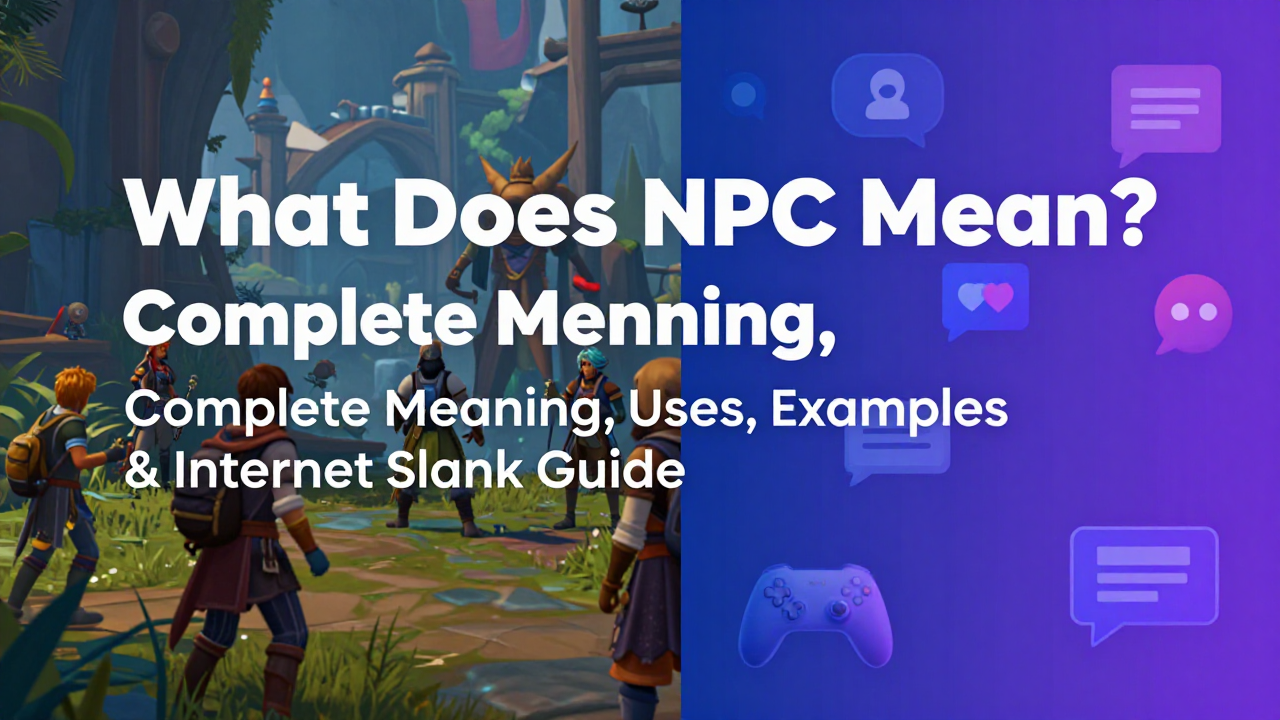
Direct Answer: What Does NPC Mean?
NPC stands for Non-Player Character. In video games, an NPC is a character controlled by the game’s programming rather than by a human player. NPCs help create stories, provide quests, sell items, give information, or make game worlds feel more realistic. The term has also become popular on social media, where it describes someone who appears to follow predictable behavior without independent thinking.
The term NPC has become increasingly popular in gaming, social media, internet culture, and online discussions. While it originally came from the gaming industry, its meaning has expanded over the years. Today, people use NPC in both technical and casual conversations, making it an important term to understand.
Whether you are a gamer, content creator, social media user, or simply curious about internet slang, understanding what NPC means can help you better navigate online communities. From role-playing games to viral TikTok trends, NPCs have become a major part of modern digital culture.
In this guide, you’ll learn the complete meaning of NPC, how it works, where it is used, its benefits and limitations, real-world examples, and other meanings associated with the acronym.
What Does NPC Mean?
NPC stands for Non-Player Character.
In gaming, an NPC is any character that exists in a game but is not controlled by a real player. Instead, the game’s artificial intelligence (AI) or programmed scripts control its actions.
NPCs can take many forms:
- Shopkeepers
- Villagers
- Quest givers
- Enemies
- Guards
- Allies
- Background characters
Without NPCs, many games would feel empty and lifeless. They provide interaction, information, challenges, and story progression.
Simple Definition
An NPC is a computer-controlled character in a video game that interacts with players but is not directly controlled by them.
How NPCs Work
NPCs operate using programmed behaviors, scripts, decision trees, or artificial intelligence systems.
Scripted NPCs
These characters follow predetermined actions and dialogue.
Example:
- A shopkeeper always stands behind a counter.
- A quest giver always provides the same mission.
AI-Driven NPCs
Modern games use advanced AI to make NPCs behave more naturally.
Features include:
- Dynamic conversations
- Realistic movement
- Adaptive combat strategies
- Emotional responses
Interactive NPCs
These NPCs respond differently depending on player choices.
For example:
- Helping a village may make residents friendly.
- Attacking villagers may make guards hostile
Types or Categories of NPCs
Different games use NPCs in different ways.
Friendly NPCs
These characters help players.
Examples:
- Healers
- Merchants
- Trainers
- Guides
Hostile NPCs
These NPCs attack players or create challenges.
Examples:
- Monsters
- Enemy soldiers
- Boss characters
Neutral NPCs
These characters neither help nor harm players unless provoked.
Examples:
- Citizens
- Travelers
- Animals
Quest NPCs
These characters assign missions and advance storylines.
Examples:
- Village elders
- Military commanders
- Kingdom rulers
Companion NPCs
These NPCs accompany players during gameplay.
Examples:
- Party members
- Bodyguards
- Story companions
Common Uses of NPCs
NPCs serve many purposes in games and virtual environments.
Storytelling
NPCs provide background information and help build the game’s narrative.
Quest Distribution
Many games rely on NPCs to assign missions and objectives.
Economy Management
Shopkeepers and merchants allow players to buy and sell items.
World Building
NPCs make cities, towns, and environments feel alive.
Training and Tutorials
NPCs often teach players game mechanics.
Benefits of NPCs
NPCs offer numerous advantages for game developers and players.
Improved Immersion
A game world feels more realistic when populated with characters.
Better Storytelling
NPCs deliver dialogue, lore, and emotional depth.
Enhanced Gameplay
Players receive guidance, challenges, and rewards.
Dynamic Interactions
Advanced NPCs can react to player actions.
Richer Game Environments
NPCs make virtual worlds appear populated and active.
Key Benefits Table
| Benefit | Description |
| Immersion | Makes worlds feel alive |
| Guidance | Helps players understand objectives |
| Storytelling | Advances narratives |
| Economy | Supports trading systems |
| Interaction | Creates engaging experiences |
Limitations of NPCs
Although NPCs are useful, they also have limitations.
Predictable Behavior
Many NPCs repeat the same actions and dialogue.
Limited Intelligence
Some NPCs cannot adapt to unexpected player actions.
Repetitive Conversations
Older games often reuse identical responses.
Resource Demands
Advanced AI-powered NPCs require more computing power.
Limitations Table
| Limitation | Impact |
| Predictability | Reduced realism |
| Limited Responses | Fewer interaction options |
| Development Costs | More resources required |
| AI Complexity | Can increase bugs |
NPC vs Player Character Comparison
Understanding the difference between NPCs and player-controlled characters is important.
| Feature | NPC | Player Character |
| Controlled By | Game AI | Human player |
| Decision Making | Programmed | User controlled |
| Dialogue | Scripted | Player choice |
| Objectives | Assigned by developers | Determined by player |
| Flexibility | Limited | High |
Real-World Examples of NPCs
NPCs appear in thousands of games across multiple genres.
Open-World Games
In games like the open-world RPG genre, NPCs:
- Walk around cities
- Offer quests
- Run shops
- Participate in events
Role-Playing Games (RPGs)
NPCs often provide:
- Story information
- Character development
- Side missions
Multiplayer Online Games
NPCs can function as:
- Vendors
- Trainers
- Bankers
- Event organizers
Simulation Games
NPCs represent realistic populations.
Examples include:
- Citizens
- Workers
- Tourists
- Customers
NPC Meaning in Internet Culture
In recent years, NPC has become popular internet slang.
Social Media Usage
People sometimes use NPC to describe someone who:
- Repeats common opinions
- Appears highly predictable
- Follows trends without questioning them
This usage is often humorous or critical.
Example
Someone may comment:
“He’s acting like an NPC.”
This suggests the person appears to be behaving automatically or without original thought.
However, because the term can sometimes be used negatively, it’s important to understand the context before using it.
NPC in Artificial Intelligence and Virtual Worlds
Modern AI technology has transformed NPC development.
Advanced AI NPCs
Today’s NPCs can:
- Hold conversations
- Learn from interactions
- Adapt behavior
- Simulate emotions
Future Possibilities
Future NPC systems may include:
- Real-time language generation
- Personalized interactions
- Long-term memory
- More realistic personalities
These advancements could make virtual worlds significantly more immersive.
Other Meanings of NPC
Although Non-Player Character is the most common meaning, NPC can represent other terms depending on the industry.
| NPC Meaning | Industry |
| Non-Player Character | Gaming |
| National People’s Congress | Government and Politics |
| National Productivity Council | Business |
| Nuclear Power Corporation | Energy |
| National Petroleum Construction | Engineering |
| Nutrition Planning Committee | Healthcare |
Always consider the context when interpreting the acronym.
Expert Tips for Understanding NPCs
Learn the Context
Determine whether NPC is being used in gaming or internet slang.
Don’t Assume Negative Intent
Online discussions may use NPC jokingly rather than as an insult.
Explore Different Game Genres
NPC roles vary significantly across RPGs, simulations, and action games.
Understand AI Evolution
Modern NPCs are becoming increasingly intelligent due to advances in artificial intelligence.
Observe Interaction Systems
Notice how different games design NPC behavior to create unique experiences.
FAQs
What does NPC stand for?
NPC stands for Non-Player Character, a game character controlled by software rather than a human player.
What is an NPC in gaming?
An NPC is a computer-controlled character that interacts with players and supports gameplay.
Are enemies considered NPCs?
Yes. Many enemy characters are NPCs because the game’s AI controls them.
Can NPCs talk to players?
Yes. Many NPCs provide dialogue, quests, tutorials, and story information.
Why are NPCs important?
NPCs help create immersive worlds, advance stories, and provide meaningful interactions.
What does NPC mean on social media?
On social media, NPC often refers to someone perceived as acting predictably or following common trends without much independent thought.
Are NPCs powered by artificial intelligence?
Many modern NPCs use AI systems, although some still rely on simple scripts.
What’s the difference between an NPC and a player character?
A player character is controlled by a human player, while an NPC is controlled by the game.
Can NPCs learn from players?
Advanced AI-powered NPCs can adapt to player behavior, although traditional NPCs usually cannot.
Are NPCs used outside video games?
Yes. NPC-like characters are increasingly used in virtual reality, simulations, educational software, and AI-driven digital environments.
Conclusion
NPC, or Non-Player Character, is one of the most important concepts in gaming. These computer-controlled characters help build immersive worlds, guide players through stories, provide services, and create meaningful interactions. Without NPCs, most modern games would feel empty and less engaging. As technology evolves, NPCs continue to become more intelligent, realistic, and interactive.
Beyond gaming, the term NPC has also become a widely recognized part of internet culture and social media conversations. Understanding both meanings helps you interpret online discussions accurately and appreciate the role NPCs play in modern digital experiences. Whether you’re a gamer, developer, or curious internet user, knowing what NPC means gives you a better understanding of today’s digital world.
Read More Related Articles
- Canada Travel Guide: The Ultimate Guide to Exploring Canada
- Russia Online Business Ideas: Best Digital Opportunities to Start in Russia
- What Does ATP Mean? Definition, Uses, Benefits, and Real-World Examples
